



Will the Gold Rate Decrease in the Coming Days? Gold Price Forecast 2026-2030
Gold price forecast 2026: Gold is currently hovering within a narrow price range of $3900 and $ 4100, and according to multiple analysts, it is expected to trade below $ 5,000 by the end of 2026.
Gold Price Performance Chart
| Last 5 Days | +4.1% |
| Last 1 Month | -5.1% |
| Last 6 Months | -7.1% |
| Last 12 Months | +23.9% |
Will the gold rate decrease in the coming days?
Gold Drops Below $4150: Gold prices slipped below $4150 as a steady U.S. dollar and stable Treasury yields limited the recent recovery. Although weaker U.S. jobs data has reduced expectations of an aggressive Federal Reserve, the latest services data was not weak enough to trigger a major selloff in the dollar. Investors still see a strong chance of a Fed rate hike by December, while the 10-year U.S. Treasury yield remains elevated near 4.45%. This is putting pressure on gold because higher bond yields make the non-yielding metal less attractive.
In the coming days, gold could remain volatile and may face further downside pressure if the dollar and Treasury yields stay firm. The next major signals will come from the Fed meeting minutes, U.S. jobless claims, and the July 14 inflation report. If these show sticky inflation or support further rate hikes, gold could fall further. However, weaker economic data or softer inflation could reduce rate-hike expectations and help gold resume its recovery. For now, the short-term outlook is cautious, with the dollar and Fed expectations likely to control the next major move.
World Gold Council’s H2 2026 gold market outlook
- The World Gold Council expects the second half of 2026 to be a crucial period for gold, with prices driven by geopolitical risks, interest rate expectations, US dollar movements, central bank buying, and investor sentiment.
- Gold hit a record high of $5,405 per ounce in January before falling to $4,002 in June. Despite the correction, gold remains one of the best-performing assets over the past 12 months.
- According to the World Gold Council’s GRAM model, geopolitical tensions were the biggest driver of gold prices in the first half of the year. Profit-taking, portfolio rebalancing, and changing expectations for interest rates and the US dollar also influenced price movements.
- The report highlights that most gold price declines occurred during US trading hours, while rebounds were largely driven by Asian trading sessions, reflecting the growing influence of Asian investors in the global gold market.
- Key downside risks for gold include a stronger US dollar, higher-than-expected interest rates, and improving investor appetite for risk assets. A sustained move below $4,000 could trigger additional selling, although declines of more than 10% may attract long-term buyers looking to buy the dip.
- Gold could regain bullish momentum if economic conditions weaken, geopolitical tensions escalate, interest rate expectations shift toward easing, or long-term investors increase their allocations. Under these conditions, gold could recover toward $4,500 per ounce, while a move to $5,000 would require significantly stronger bullish catalysts.
- Central bank demand remains a major source of support. The World Gold Council’s 2026 central bank survey indicates that many central banks still plan to increase their gold reserves, reinforcing long-term demand.
- The report also notes that India’s efforts to curb gold imports, combined with a potential slowdown in its economy, could reduce consumer and investment demand during price corrections.
- The World Gold Council concludes that gold’s long-term resilience is supported by structural demand from central banks, institutional investors, and consumers, even though interest rates will remain one of the most important factors influencing prices in the second half of 2026.
Gold Price Prediction 2026: The average of the latest 5 forecasts for 2026 is $4900. [Read details later in this post].
- JPMorgan just turned cautious on gold in the short term. The bank cut its Q4 2026 forecast by roughly 25% to $4,500 per ounce, down from around $6,000.
- India’s gold demand remained weak in May and early June due to a seasonally slow period, an inauspicious Hindu calendar phase, and volatile prices that kept buyers cautious. Demand for gold bars and coins was also flat, while retailers relied more on old-gold exchange transactions, which now account for a larger share of sales. The Prime Minister’s appeal to limit gold buying appears to have reduced purchases in urban areas, though the impact was smaller in rural regions. Some demand has returned recently as gold prices eased, but the industry expects overall demand to stay soft through June and July before improving from August with the start of the festive buying season.
- UBS Group has slashed its near-term outlook on the yellow metal, though the bank still sees prices reaching higher over the longer horizon. The Swiss bank said it sees prices drop by another $300-$900/oz., citing what it calls a “double whammy” of stronger US economic data and a delayed Federal Reserve easing.
- The WGC 2026 Central Bank Gold Reserves Survey, published recently, showed that 89% of reserve managers expect global central bank gold holdings to increase over the next 12 months, while a record 45% expect their own institutions to add to their reserves.
- DBS Group, Singapore’s biggest bank by assets, will offer tokenised physical gold to retail customers as demand for the precious metal grows and the city-state pushes to become a gold trading hub.
Gold Price Forecast Today: Short-Term Signals
Our analysis considers five main factors—DXY, US 10-year Treasury Yield, Gold Demand, Technicals, and Uncertainty—to predict whether the gold rate will decrease in the coming days. What are the Signals for Today?
Overall, the short-term Gold price predictors are bearish.
Bullish Indicators
- Gold ETF and Central Bank Demand Remains Bullish.
Neutral Indicators
- No neutral indicators.
Bearish Indicators
- Gold Consumer Demand is partially bearish [Neutral in China, Bearish in India].
- Technical indicators are bearish (short-term).
- Macros are bearish for Gold
- DXY Trend – DXY is rising. [Bearish for Gold]
- U.S. 10-Year Treasury Yield – US 10Y is rising. [Bearish for Gold]
Gold Price Forecast – Technical Analysis Today
Gold reversed the bearish trend and the price surged back above $4000. Gold has been holding above this level but the buying pressure has subsided and the overall outlook is once again bearish.
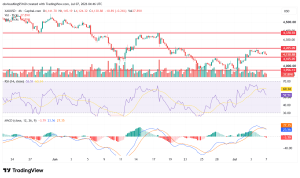
Gold is losing some of its recent strength on the 4-hour chart after failing to break above the $4,205 resistance level. The price has slipped to around $4,129 and is now below the 10 and 20-period EMAs and SMAs, showing weakness in the short term. It is still above the 30 and 50-period moving averages, so the recent recovery has not completely broken down. However, trading below the 100 and 200-period averages keeps the broader trend under pressure.
The RSI (14) has dropped to 52.08 from recent highs above 60. It is still slightly above the neutral 50 level, but the sharp fall shows that buying momentum is fading. The RSI is also below its signal average at 60.31, which adds to the weaker short-term picture. Buyers still have some support, but they are clearly losing control after the failed move near $4,205.
The MACD has also weakened. The MACD line is now below the signal line, while the histogram has turned negative at -3.93. The MACD Level (12,26) remains positive near 24.28, but the sell signal shows that the recent upward momentum is slowing. The Momentum (10) indicator has also fallen to -52.22, suggesting that sellers have gained strength over the last few sessions.
From a price action point of view, $4,105 is now the key level to watch. Gold is trading only slightly above this support, and a clear break below it could push the price toward $3,956. On the upside, $4,205 remains the main resistance, and buyers need to move above this level to restart the recovery toward $4,379. For now, the short-term outlook is cautious, with downside risk increasing if $4,105 fails to hold.
| Timeframe | Gold Spot Prediction Range |
| Gold Price Prediction Today and Tomorrow | $4100 to $4210 |
| Gold Price Forecast for Next Week | $3800 to $4200 |
| Gold Price Prediction for the next 1 month | $3800 to $4600 |
Gold Price Outlook Next week
Gold may remain volatile this week and could move in either direction. The trend is still weak, so any rise in price may face selling pressure. At the same time, because prices have fallen sharply, a short-term bounce is possible. Overall, gold is expected to trade between $3500 and $4400 over the next week, with downside risks still slightly higher than upside.
Gold Price Forecast 2026: Medium-Term and Long-Term Forecasts
Gold prices can rise between 15% and 30% in 2026, according to the World Gold Council (WGC). This comes after an exceptional surge in 2025, driven by investor demand amid US tariffs, geopolitical tensions, and strong central-bank buying. Interest-rate decisions and continued accumulation by global central banks were major contributors to the 2025 price rally. Gold gained around 65% in 2025. However, the WGC also warns that gold could decline 5% to 20% in 2026 if Donald Trump’s economic policies succeed in generating stronger-than-expected US growth. A solid fiscal boost could strengthen the US dollar and reduce safe-haven demand, putting pressure on gold prices.
Key Factors That Could Impact Gold in 2026
1. Interest Rate Cuts or Delays: Lower rates typically lift gold, while delayed cuts or higher yields can weigh on prices.
2. Central Bank Gold Purchases: Continued aggressive buying by emerging-market central banks would support higher prices.
3. Geopolitical Tensions: Any escalation in global conflicts, trade wars, or political uncertainty boosts safe-haven demand.
4. US Dollar Movement: A weaker dollar lifts gold; a stronger dollar (if US growth accelerates) could push gold lower.
5. Inflation Trends: Sticky or rising inflation will continue to make gold attractive as a hedge.
Major Institutional Gold Forecasts for 2026
- Deutsche Bank has sharply reduced its gold price forecasts for the second half of 2026, lowering its outlook by as much as 22% as expectations of tighter US monetary policy and weakening investor demand continue to pressure the precious metal. The bank now expects gold to average $4,300 per ounce in Q3 2026, down more than 22% from its previous estimate, and $4,800 per ounce in Q4 2026, a 17% reduction from its earlier forecast.
- Gold Forecast for 2026: $4300
- Goldman Sachs: Goldman Sachs has lowered its year-end 2026 gold price forecast to $4,900 per ounce from $5,400, citing expectations that the Federal Reserve will keep interest rates higher for longer. Despite the downgrade, the bank remains constructive on gold over the long term, supported by structural demand from central banks.
- Gold Forecast for 2026: $4900
- ING: ING has cut its gold outlook, forecasting an average price of $4,300 per ounce in Q3 2026 and $4,600 per ounce in Q4 2026. The bank expects higher US interest rates, a stronger dollar, and weaker ETF inflows to keep pressure on bullion prices.
- Gold Forecast for 2026: $4600
- Morgan Stanley: Morgan Stanley continues to project gold could reach $5,200 per ounce in the second half of 2026.
- Gold Forecast for 2026: $5200
- UBS: UBS has moderated its gold outlook, reducing its forecast from $6,200 to around $5,500 per ounce.
- Gold Forecast for 2026: $5500
Gold Price Predictions for Next 5 Years
Beyond 2026, gold will mainly depend on a few long-term trends. Many central banks are buying more gold to reduce their dependence on the US dollar, which keeps demand strong. Global interest rates are expected to decline gradually in the coming years, which typically supports gold prices.
Geopolitical tensions, trade issues, and shifting world politics can also keep gold important as a safe-haven asset. Technology may play a role too, with digital gold and tokenized gold making it easier for people and institutions to invest.
Overall, beyond 2026, gold’s direction will be shaped more by global stability, central bank buying, and investor behaviour rather than short-term market movements.
Gold Price Prediction 2030
Gold is expected to remain a key safe-haven asset even in 2030. Many analysts suggest that gold may continue rising through the end of this decade, driven by factors like inflation, geopolitical uncertainty, safe-haven demand, and strong central-bank buying.
Forecasts for 2030
- Some expect gold to reach around $6,000 per ounce by 2030, supported by steady demand and global uncertainty.
- Other projections suggest gold could average above $5,900 by 2030 in their long-term scenario.
Why 2030 Could Be Higher
- Central banks around the world are building gold reserves (trend expected to continue).
- Inflation may stay above pre-pandemic levels.
- Global political tensions and currency risks are rising.
- Lower real interest rates over time make gold more attractive.
By 2030, many long-term models suggest gold could move into the $5,900–$6,200+ range, depending on global inflation, central bank demand, and geopolitical conditions.
- Gold Price Prediction 2030 is $5900-6200.
Is Gold a Good Investment?
Gold is viewed by many as an inflation hedge and a must-have in their investment basket. There are some unique properties of Gold as an Investment
- It tends to deliver above-inflation returns
- It tends to underperform equity indices
- It tends to perform well when interest rates are trending lower
- It tends to outperform equity indices when the economy is in a downturn and hence a good way to diversify risk in the portfolio.
Conclusion: Gold prices may experience short-term consolidation, but the broader outlook remains bullish. With strong central-bank buying, expected rate cuts, and ongoing global uncertainty, gold is well-positioned to test $5,000 in 2026 and potentially move toward $6,000 by 2030 under favorable macro conditions.
Will Gold Price Breach $5000 in 2026?
Whether or not the price of gold will breach $5,000 in 2026 is a difficult question to answer, as it depends on several factors, including the global economic outlook, geopolitical tensions, and investor sentiment.
However, there are several reasons to believe that the price of gold could reach $5,000 or higher in 2026. First, the global economic outlook is uncertain, particularly after the election of Donald Trump in the United States.
On the other hand, geopolitical tensions are on the decline, with Ukraine likely to be pushed to seek a compromise with Russia. The Middle East conflict is also on the decline. It is unclear if the US and China are likely to enter into any conflict, but there are no signs of that at the moment.
Third, investor sentiment towards gold is positive. A recent survey by the World Gold Council found that 43% of investors believe that gold prices will rise in the next 12 months. This is the highest level of investor optimism towards gold since 2011. Additionally, two big economies of the world, China and India’s Central Banks have once again resumed their gold buying spree.
Overall, several factors suggest that the price of gold could reach $5,000 or higher in 2026.
How has the Gold Price changed in the Last 10 Years?
| Year | Average Gold Price (USD per ounce) |
| 2013 | $1,410 |
| 2014 | $1,266 |
| 2015 | $1,159 |
| 2016 | $1,252 |
| 2017 | $1,260 |
| 2018 | $1,282 |
| 2019 | $1,523 |
| 2020 | $1,895 |
| 2021 | $1,829 |
| 2022 | $1,802 |
| 2023 | $2036 |
| 2024 | $2641 |
| 2025 | $4320 |
| 2026 | $4018 (June 30) |
Why is the gold price falling?
Gold remains under pressure mainly because of two reasons. First, the US dollar has become stronger as investors expect the Federal Reserve to keep monetary policy tight. A stronger dollar and higher bond yields reduce the appeal of gold because gold does not pay interest. At the same time, tighter financial conditions reduce liquidity in the market, putting additional pressure on gold and other risk assets.
Second, China has slowed its liquidity injections since March 2026. China has been one of the world’s biggest buyers of gold, and lower liquidity means there is less money flowing into the precious metal. This has weakened demand for gold at a time when it is already facing pressure from a stronger US dollar.
If markets stop expecting a very hawkish US Fed or if China’s central bank starts injecting more liquidity again, gold could find a bottom and resume its long-term uptrend.
Note: Please consult a registered investment advisor to guide your financial decisions.